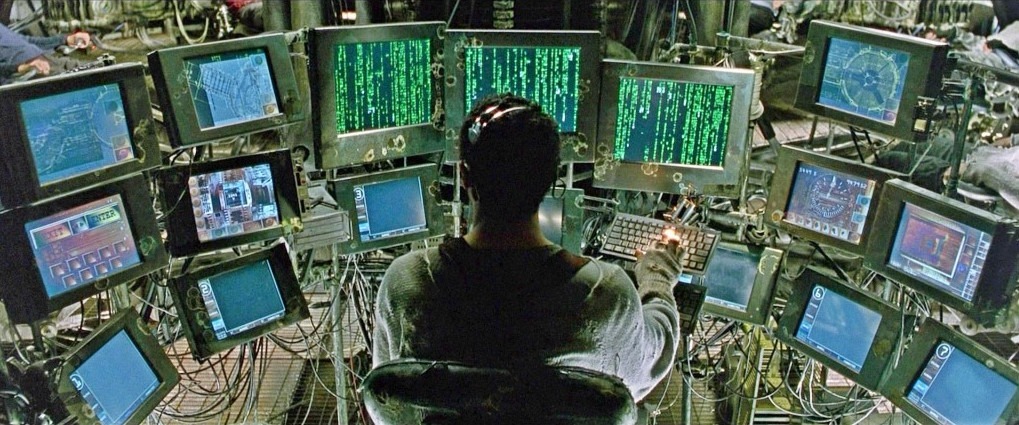
This week I sat at my screen watching several Claude Code sessions run at the same time. Each had spawned its own army of subagents - one crew reviewing code while another dug through a database schema, responses scrolling up faster than I could read them. The feeling was instantly familiar, and it took me a second to place it: The Matrix.
Not Neo, though. The operator. Tank, sitting in a beat-up chair on the Nebuchadnezzar, never entering the Matrix at all. His job was the screens and the machinery. When Trinity needed to fly a helicopter she had never touched, she didn't learn to fly. She called her operator - "Tank, I need a pilot program for a B-212 helicopter" - and seconds later she was lifting off a rooftop. When Neo needed a decade of martial arts, Tank loaded it in seconds. "I know kung fu!" said Neo, astonished.
The crew never mastered everything. They mastered something better: knowing exactly what to call for, and when.
The new craft
That is the new craft, and I don't think most people have named it yet. I call it the AI Operator. Operating AI is a skill. Can anyone open a chat window and get something useful back? Sure. But the outcomes vary wildly, and they vary on two things people keep collapsing into one: the model, and the operator.
The model, and the operator
The model matters, and it matters enormously. I'm writing this with the most powerful and most expensive model I can lay my hands on, and the difference is not subtle. It's fashionable to say models are becoming a commodity. The people saying that haven't pushed one hard enough to find its ceiling. The model sets the ceiling.
The operator decides how much of that ceiling you actually reach. Give two people the same model and watch what happens. One has encounters - an intelligent but unfocused assistant, brilliant one day and useless the next, remembering neither. The other runs a system: known tools applied to known situations, knowledge that accumulates instead of evaporating.
A craftsman brings their own tools
But an operator is only as good as what's on their bench. A brilliant operator with a generic toolkit is a master mechanic handed an empty toolbox - all that judgment, nothing to apply it with. And the best operators don't borrow a stock kit. They build their own.
Walk into any great mechanic's garage and you'll find a wall of tools worn to their hands - specific, customized, arranged exactly how they work fastest. Mine looks like a roster of specialists I summon on command. When I need a database index tuned, I don't become a DBA - I call a sql-engineer, defined once, spun up in seconds, gone when the work is done. A security-auditor when I need someone to think like an attacker. A writer that already knows my voice. Kung fu on demand.
Routing the right tool to the right job is most of the craft. You don't send the heavyweight model to check a git status, and you don't send the cheap fast one to design your architecture. You learn what a task should cost and what quality to expect back for the price. You feel when ten agents in parallel will beat one, and when they absolutely won't. Somewhere in there, you stop prompting and start operating.
What the machinery is for
America turns 250 tomorrow, which is why the other half of the metaphor won't leave me alone. The operators in The Matrix never threw a punch. Their entire job was running the machinery of the free world, so the people doing irreplaceable work were free to go do it.
That is the honest version of what all this AI machinery is for. Not replacing people. Buying their time back from the work that wastes it - the report that takes three days to produce, the institutional knowledge trapped in one person's head. Freedom, in a working life, is time for the work only you can do. Two hundred and fifty years in, plenty of brilliant people still don't have that kind of freedom between nine and five.
The machinery finally exists. What it needs is operators - with good tools, and the skill to use them.
Happy 250th, America. And a question, operator to operator: what's the first program you'd load?